
100W MOSFET power amplifier.
A 100W MOSFET power amplifier circuit based on IRFP240 and IRFP9240 MOSFETs is shown here. The amplifier operates from a +45/-45 V DC dual supply and can deliver 100 watt rms into an 8 ohm speaker and 160 watt rms into a 4 ohm speaker. This Hi-Fi amplifier circuit is suitable for a lot applications like general purpose amplifier, guitar amplifier, keyboard amplifier. The amplifier can be also used as a sub woofer amplifier but a subwoofer filter stage has to be added before the input stage. The amplifier has a low distortion of 0.1%, a damping factor greater than 200, input sensitivity of 1.2V and the bandwidth is from 4Hz to 4 KHz.
Circuit diagram.

About the circuit.
Capacitor C8 is the input DC decoupling capacitor which blocks DC voltage if any from the input source. IF unblocked, this DC voltage will alter the bias setting s of the succeeding stages. Resistor R20 limits the input current to Q1 C7 bypasses any high frequency noise from the input. Transistor Q1 and Q2 forms the input differential pair and the constant current source circuit built around Q9 and Q10 sources 1mA. Preset R1 is used for adjusting the voltage at the output of the amplifier. Resistors R3 and R2 sets the gain of the amplifier. The second differential stage is formed by transistors Q3 and Q6 while transistors Q4 and Q5 forms a current mirror which makes the second differential pair to drain an identical current. This is done in order to improve linearity and gain. Power amplification stage based on Q7 and Q8 which operates in the class AB mode. Preset R8 can be used for adjusting the quiescent current of the amplifier. The network comprising of capacitor C3 and resistor R19 improves high frequency stability and prevents the chance of oscillation. F1 and F2 are safety fuses.
Circuit setup.
Set R1 at midpoint before powering up and then adjust it slowly in order to get a minimum voltage (less than 50mV0 at the output. Next step is setting up the quiescent current and keep the preset R8 in minimum resistance and connect a multimeter across points marked X & Y in the circuit diagram. Now adjust R8 so that the multimeter reads 16.5mV which corresponds to 50mA quiescent current.
Notes.
- Assemble the circuit on a good quality PCB.
- Use a +45/-45 V DC, 3A dual supply for powering the circuit.
- Power supply voltage must not exceed +55/-55 V DC.
- Before connecting the speaker, check the zero signal output voltage of the amplifier and in any case it should not be higher than 50mV. If it is higher than 50mV, check the circuit for any error. Replacing Q1, Q2 with another set could also solve the problem.
- Fit Q7 and Q8 to a 2°C/W heat sink. Both Q7 and Q8 must be isolated from the heat sink using mica sheets. Heat sink mounting kits for almost all power transistors/ MOSFETs of almost all package styles are readily available in the market.
- All resistors other than R10, R11 and R19 are 1/4 watt metal film resistors. R10 and R11 are 5W wire wound type while R19 is a 3W wire wound type.
Power supply for the 100W MOSFET power amplifier.
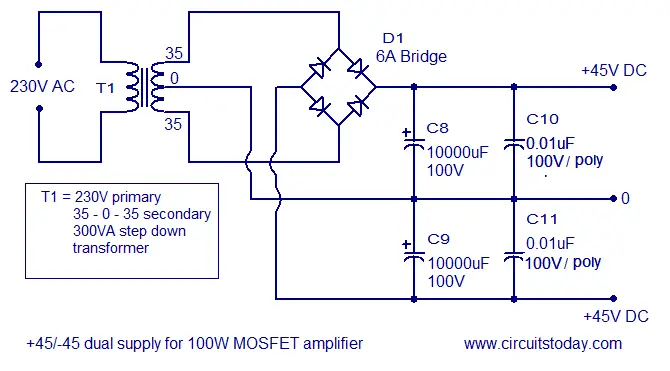
A basic dual power supply is used for the amplifier circuit. If 6A ampere bridge is not available, then make one using four 6A6 diodes.C10 and C11 are high frequency bypass capacitors. Filter capacitors C8 and C9 must be at least 10000uF, higher the value lesser the ripple. Optional 3A fuses can be added to the +45 and -45 lines. Transformer T1 can be a 230V primary, 35-0-35 V secondary, 300VA step down transformer.

This amplifier will burn.. Vertical MOSFETs need temperature compensation of the bias !!!!!
i have a 24-0-24 5Amp. transformer is this suitable for this amplifier?
sir we build this circuit for our project and everything’s fine it is DISTORTED what shuold we do ?
dear ryan…
please check the input. it’s possible the output signal distorted if input signal is too high.
so reduce the input and check.
still problem is exist then check the power supply.
power supply should be well regulated and keep voltage range between 35-0-35 to 55-0-55
let me now what output you get
hello seetharaman sir…
I have tried this circuit but output is too low
predicting output volume is less as compare to 30 watt apmlifier.
everything is fine and correct.
only the thing is I have used multiturn trimmer instead of multiturn pot
is this problem occurs because of multiturn trimmer?
second is whenever I switch on the circuit I required to adjust quiescent current (i.e multiturn trimmer R8)
always. because whenever I switch on the circuit the quiescent current is different than I adjusted prior.
what is wrong? and what to do?
please help me
waiting for reply..
thank you.
dear dhiraj….
don’t use multiturn trimmer instead of pot
replace trimmer with pot and let me what output you get
sorry
*let me know what output you get*
seetharaman sir I am waiting for your precious reply…
please reply as soon as possible
thank you.
respected seetharaman sir….
I want more than 200 watts
is it possible if I add one or two more pair of IRFP240 and 9240??
if I add two more pair of same MOSFET i.e total three pair of MOSFET then what should be the value of source resistor and gate resistor of each pair ???
and what will be the output power for three pairs of MOSFET if I m using power supply of +/-50 volts 3 amp. ???
I have transformer of 35-0-35 3 amp. secondary. at the output I m getting +/-50 to 55 volts>
se voce fizer isso tera que aumentar a amperagem do trafo
speak in english
Try this 300W Hi-Fi mosfet Amplifier http://adf.ly/vNFeo. The sound is superb.
http://adf.ly/vLIxB link of 100W subwoofer amplifier PCB layout comes from Sir Seetheraman install Pad to Pad software to open PCB file. Thank you sir for the PCB layout. GOD BLESS.
PADS says “Job not compatible with current version of program” Could you make a utiliboard file or one I can open with my version of PADS?
sir,
please provide me a pcb layout of 100 watt MOSFET audio amplifier.
hey.. seetharaman sir..
can I use 2 circuits of this amplifier on single power supply as shown in above post i.e -45/45 volt 3 amp.?? in which I used the transformer of 35-0-35 volt 3amp.
If no, then what should I change in power supply ???
*I have 35-0-35 volt 3amp. transformer*
also,
If I want to use more than two circuits of this amplifier on single power supply then what to do with transformer and power supply circuit according to no. of circuits???
plzzz reply sir…
For stereo you have to double the current of transformer.
pascual…
my question was different ….
I want to use this amplifier circuits on single power supply
means…
e.g. two amplifier circuits with only one power supply
or three amplifier and with one power supply
hey.. seetharaman sir..
can I use 2 circuits of this amplifier on single power supply as shown in above post i.e -45/45 volt 3 amplifier in which I used the transformer of 35-0-35 volt 3amp. ????
If no, then what should I change in power supply ???
I have 35-0-35 volt 3amp. transformer
also,
If I want to use more than two circuits of this amplifier on single power supply then what to do with transformer and power supply circuit according to no. of circuits???
plzzz reply sir…
thank you.
sir what is the cause of HIZZZ….. sound in the amplifier and how to eliminate this?
What is the purpose of the resistors R1 and R8 being variable? Also what use capacitors C1 and C2 in parallel? Why not use a single capacitor?
Thanks
R1 to make zero current flow thrbough speaker. R8 to adjust no signal current adjustment of 50mA. C1 is used to take care of HF decoupling, as C2 is wound capacitor with inductive componunt and for LF decoupling.
Pretty useless. If you try to build, it will not work, as they have not included a lot, what you see is only the tip of the ice-burg. what they cant explain actually makes a circuit work.
yashhhhhhhh……
finally I succeed…………..
thank you so much…
Hi sir,
I am planning to make a 2.1 sound system with your circuit.
The spec is given below, also I have some doubts regarding the project. It will be great if I get your valuable suggetions.
Spec
======
drivers :
1. 12 inch 100 watts 4 ohms subwoofer – 1
2. 10 inch 50 watts 8 ohms woofer – 2
3. 8 inch 50 watts midrange – 2
4. tweeter – 2
amplifiers:
1. 150 watt RMS at 4 ohms drivers – 3
( 1 for subwoofer and 2 for left and right channel)
20 – 200 hz lowpass filter – 1
low mid high control board – 2 ( for left and right channels)
low mid high passive cross over – 2
my doubts :
1. do I need to use a preamp in this circuit ? because I am splitting the input into two different amplifiers (sub and left right). I think preamp will just only increase the voltage level of the input signal, but when we split a signal into two actually the current is divided into two. Will the preamp be helpful in current gain?
2. I will use 20-200 hz lowpass filter before the subwoofer amplifier, do it act as a preamp ?
3. In common I have seen bass and treable control knobs in amplifiers but I want to use low, mid and high controls, is it okay? if yes please suggest me some links to get low, mid and high control board circuits.
4. I am planning to fix all these circuits in a single casing so can i use a single transformer to the entire system, if yes please specify the voltage and amps.
5. i have heared that the amplifier should be 50% more powerfull than the drivers to get good performance at max volume levels , so I decided to upgrade your circuit from 100 watt to 150 watt, so what kind of changes should I do with the given circuit ?
6. I want to add a short circuit or overload protection fuse in this system, suggest some links to get some idea about this.
7. One woofer, midrange and tweeter will be connected parallely to the one channel of stero amplifier, so I think two 8 ohms drivers can make 4 ohms load. I didn’t considered the tweeters impedence. Do the tweeter have impedence ? or is it significant ?
8. Im also planing to do a LED spectrum analyser and digital volume controls with remote. These features will be added later. If u have ideas about these please share.
Thank you sir
jithin pv
ufffff…..
please somebody help me
I am getting new problems again and again everyday in this circuit
and I make changes everyday to sort out the problem
today zero signal output is less than 50mV but there is no voltage across x and y point
so I checked the MOSFET, it was dead so I replaced it by new one
and again I saw the voltage across the x and y point it was varying and never stay stable.
hence I change the R8 slowly and change in R8 caused to overheating of MOSFET and again my MOSFET is dead.
all other is well…. but I am getting trouble with quiescent current and MOSFET only
when I checked the MOSFET by separate it from circuit after it blew up the gate and drain pin of IRFP240 and gate and source pin or IRFP9240 is showing shorted on multimeter.
what can be the reason behind damage of MOSFET.
zero signal output of my circuit is 2 to 4 mV is this okay???
and what to do for unstable quiescent current.
of course my resistor is not 0.33+0.33 it is total 1 ohm
so the voltage across x and y point should be the 60 to 65 mV.
this is the third time my MOSFET dead.
when I was testing the circuit second time I connected 4 ohm speaker and input was from mobile phone.
output was totally distorted. I thing it was because of one MOSFET is damage from both and one is on.
but gain was less than 8 watt. because I was connected 8 watt speaker and I thought speaker should blow up but it didn’t happen rather the volume was so less than the volume in 10 watt amplifier.
what can be the reason behind of less gain.
gysss… I am suffering from various problem
but I want to success at any cost
I spend all the pocket money for this circuit and now I don’t have money so, I cant leave this circuit without get success
please share something….I need your suggestions I need your help
seetharaman sir please reply.
hiiee seetharaman sir
I solve this problem
now,
zero signal output is less than 50 mV(varying between 25 to 40 mv) and voltage across X n Y point is 160 mV since R10 and R11 is 1.5 ohms
but the problem is both MOSFET heating too much within 2 minute averaged so that the soldering flux at pin of MOSFET also melts.
power supply is +/- 55 volt
is the reason behind of heating MOSFET is few extra voltage????
I don’t thing so because temp. of both MOSFET within 2 minute is so huge. if I power up the circuit for more than 2 min then I am sure that both MOSFET will blew up
what is the reason behind of this?? anyone can suggest? what to do for this huge heat??? how to solve this???
seetharaman sir please please please reply…..
I need your help…
hiiee….
seetharaman,
something wrong with my circuit
all the connections are right, all the components are in good condition,
all components have appropriate rating values, I have used Q7 IRFP9140 in the place of IRFP9240, and R10 n R11 is 1.5 ohm
power supply is +/-55 volts
when I power up the circuit nothing any burns but the reading of zero signal output is 17 volts…. and voltage across X and Y point mark in the circuit is zero volts
I have check voltage across drain to source of Q8 n Q7
Q7 drain to source and drain to gate is 37 volts
Q8 drain to source and drain to gate is 71 volts
gate to source is zero volts for both Q7 n Q8
can you tell me what the problem with my circuit
all readings are unexpected like zero signal output
it’s 17 volt where it should be 50mv
and adjusting R1 does not affects zero signal output
as well as adjusting R8 also does not affects voltage at X n Y point
but when I checked R1 n R8 pot its working properly rather I replaced it but same problem exist
what to do pleas help me….
The amp works fine. Of course R17 must be 470 ohm. With 47 Kohm you get no sound, Q1 and Q2 remains closed.
Q8 blew up to.
What happened to R6, R7, R8, R9, R10, R11 and R14 are they burnt. Which are the resistances burnt. This give a clue about your problem. Hope you have not exceeded + / – 45 volts DC and used fuse also. Hope you have kept R1 at center and R8 at minimum value before switching on your amplifier.
The resistors seems to be fine. I disconnected the circuit from mains quicker than the fuses. Could the root of this problem be an overheated transistor when soldering? I think that i might did that with some of the mje´s as i soldered them of from another pcb.
up to 30 seconds with 275 to 300 deg C should not matter. might have been defective ones. to quick check do not connect MOSFETS with just other transistors switch on check the voltages it should give a fair idea about the circuit healthiness. Once things are fine set current adjusting pot to minimum value switch on with new MOSFETS and with a dummy load of 25 ohms without speaker.If things are ok set the current as recommended, and connect 8 ohms speaker and try.
As I powered up, Q5, Q6, and Q7 blew up. Something must be terribly wrong with my circuit. Any suggestions on where the error could be located?
In the centre of Q4 & Q5 base to collector is that jumper ?
It is a temperature compensated constant current mirror. The current through Q5 and Q6 will be identical.
Thank you sir, god bless you
If i connect 25v 5amp ac and 10inch 4ohm subwoofer, what power will actually get when it use as a subwoofr amp? Please help me sir
You cannot use 25 volt transformer. you have to use 25 – 0 – 25 volt 5 Amp transformer with bridge rectifier and filter capacitors to get plus and minus 35 volt power supply for the amplifier. With this power supply and 4 ohms load (speaker) you will get 100 watts RMS output power.
c my sub own design sub pre and surr stereo effects pls contact me 9943489494 give ur id i frwdng u my circuit
If i connect 25v 5amp ac and 10inch 4ohm subwoofer, what power will actually get when it use as a subwoofr amp?
Can i use it as a subwoofr amp? What power will get when i connect 10inch 4ohm subwoofr? Please help me sir
Can dis circuit wrk with bc557? Pls
Hi BC556 VCeo is 80 volt but 557 is only 50volts, hence it will be oprating at the brim and may get damaged, hence it is preferable to use BC556 only.
Can I use 20pf in place of c4 n c5??
22pf is standard value you can use or any value from 18 to 47 pf
Can i attach the mosfets from two circuits to a 1 C/W heatsink?
If you are using 2 similar amplifiers yes with proper insulating kits you can use provided the sink is sufficiently big to take care of the generated heat. If heat sink temperature is used for thermal compensation it cannot be used. It is a better practice to use separate heat sink for each different application.
Is this corect?
„Now adjust R8 so that the multimeter reads 16.5mV which corresponds to 50mA quiescent current.â€
16.5mV/0.33ohm=50mA or (R10 or R11)
16.5mV/(0.33+0.33)ohm=25mA …? (R10+R11)
Finaly the quiescent current MUST BE 50mA? Pls seed!
Hi you are correct it should be 33mV. what is written should be across one source resistance only.
If I power up six of these with the same power supply, what value should each rectifier diode have?
Hi Chiliman the bridge rectifier should be capable 25amps. The filter capacitor should be atleast 10 X 10000uF for both positive & negative supply. Instead I would like you to use separate filters and rectifier for each amplifier, you mount bridge rectifier and filter capacitors of the value shown in each circuit board. Use a single transformer may be torroid one capable of 20amps capacity
Thanks.
Is good circuit have tested it and it works well the circuit is better for very high voltage
Wich tracks carries the largest currents?
Tracks connected to Q7 Q8 source and drain and loud speaker.
Hello,
Please, could I add another 3 pairs of MOSFET at the output stage thereby making it a 400 watts??
Hello,
Please, could I add another 3 pairs of MOSFET at the output stage thereby making it a 400watts.
Hi, I have one question. Does output of this circuit is short circuit protected?
Seetharam, we need Very High Power Amplifeir circuit, like 200W, 300W, 400W, 500W, 1000W, 2000W – 5000W
Seetharaman, please post the 400W mosfet Amplifeir circuit here
süpperrrr mosfet amp
not avail the transistor mje340/350. bd139/140 not suitable.
hi,can u plz send me the full pcb layout design, inc P.S
I’ve one doubt how to ctrl the vol of the amp?
also in the electronic shop the transformer is rated in ‘A’ not in ‘va’
,is 300va=6.5A?
Sir,
Can you please provide the PCP layout..
Thanks
viswa
Hello!
First of all i want to tell you that its a VERY LOUD amplifier even with dual 27V transformer,i will try it with 40v when i buy the new transformers, i have only one question, what kind of pot is the ideal to adjust the volume?
I use a 100k pot but when i turn it off i stil have sound in my speakers, a 1M ohm pot would be good or even it will be small?
Thank you very much!
Hi Theofrastos 100K logarithmic control that should take care for volume problem at lower settings, do not use Lin controls.
sir,can i pls get the circuit theory analysis of the 100watt mosfet amplifier.my email:treborzonelife@gmail.com
sir,can i pls get the circuit theory analysis of the 100watt mosfet amplifier.
Hello, both my transistor burned out in 2 secounds (Q8 and Q7), what can cause this problem? I have also changed the value of pot R8 to 5k (i could’t find any 3k pot multiturn from my store) but i dont think it have anything to do with the burn transistors ? Thanks for the help
Hi Niklas in the place of R8 put a link. Reduce the fuse rating to 500mA. If every thing is oK it should stay alright if the fuse blows indicates something wrong in the wiring. Please check and correct and proceed as above. If it is ok replace link with say 2k2 pot and set the current through the fuse for 50 to 60 mA.
Hi… plz, provide me the pcb layout. My mail ID: prakash_bytari@yahoo.co.in
sir i want to construct an inverter using eight IRFT250N four in opposite side. what size of transformer will be suitable for this construction. thanks
whenever i connect the circuit, the resistor R7 burn out…
i could not collect the mosfet IRFP240 & IRFP9240…instead i used two IRF9240 with proper biasing. please help…
Hi, I’m a little confused here…. looking at setting R8 for 16.5mV across 2 x 0.33 ohms looks like 25mA to me? Am I missing something or should the measurement be across just 1 x 0.33 ohm OR 33mV across points X to Y? Thanks, Baz
Hi Baz you are correct.
Hi Ifte without feeding any input to the amplifier (say volume control fully closed no sound from speakers)connect a multimeter across points marked X & Y in the circuit diagram and adjust R8 so that the multimeter reads 16.5mV which corresponds to 50mA quiescent current.
1. what is zero signal output voltage of the amplifier? and how can i measure it?
Hi Harry as per following link it is a good performer.
http://schematicwiringdiagram.blogspot.in/2011/08/100w-mosfet-power-amplifier-based-on.html
tell me anyone using this amplifier is this working?
thanx Seetharaman, but this is a 400W mosfet amplifier layout how can i use it for 100 W mosfet amplifier.
Hi Harry can be used.
Use the following link for your PCB layout
http://hobbyelectronicsdri.blogspot.in/2011/06/400w-mosfet-amplifier-circuit-with.html
Dear Sir…
Can I get the PCB for the same or atleast PCB Layout…pls reply..
Ramdas
plz give me a reply………
i have a 35-0-35 5Amp. transformer is this suitable for this amplifier
hi……..
i build this amplifier but when i switch on the power supply the IRFP9240 heats up and gets burn. so what should i do. i want ur help guyz…….
reply
Hi to all
someone have the PCB layout for this amplifier?
many thanks in advance
I need 200watts(rms)amplifier circuit diagram
Pcb
This escheme was not designed for this author. This amplifier work fine, but in the scheme displayed here, have some issues. The “pots†(R8 and R1 must be mult turn), the value of R17 is not a 47K. The R17 must set a current aprox of 1mA, so, we need a 330r to 470r. R*I=U, R=?, I=0,001A U=0.650v,(equal a VBE voltage). Do the calc, and see for yourself. Be carefully for use others MOSFET. The bandwidth is 3,6Hz to 39.4KHz. Don’t exceed 55V dc for each rail. All that you need is 40+40AC 225VA trafo for each channel@160Wrms/4ohms. Good Luck.
Brazil.
T7 = IRFP240, 2SK1530, 2SJ162, BUZ900DP, BUZ901DP (take care for pin layout : GDS GSD)
T8 = IRFP9240, 2SJ201, 2SK1058, BUZ905DP, BUZ906DP (take care for pin layout : GDS GSD)
This escheme was not designed for this author. This amplifier work fine, but in the scheme displayed here, have some issues. The “pots” (R8 and R1 must be mult turn), the value of R17 is not a 47K. The R17 must set a current aprox of 1mA, so, we need a 330r to 470r. R*I=U, R=?, I=0,001A U=0.650v,(equal a VBE voltage). Do the calc, and see for yourself. Be carefully for use others MOSFET. The bandwidth is 3,6Hz to 39.4KHz. Don’t exceed 55V dc for each rail. All that you need is 40+40AC 225VA trafo for each channel@160Wrms/4ohms. Good Luck.
Hi Joel this amplifier’s bandwidth is 4Hz to 40KHz, which is quite fine for audio use. what is written is wrong a zero is missing in the upper limit.
@you can u go and check the parameter of irfp240 and see if there is any similarity at http://www.alltransistors.com
Bandwidth is too short how can i increase it i need at least 15KHz
Hi Gamerandds most economical IRFP540 / 9540 pair also can be used. It can work with 4 ohms speaker delivering around 200watts. below this impedance it is risky to operate the amplifier it may blow the FETs.
WILL THIS RUN ON 2 OHMS STABLE?
Will the Irfp250 work instead of the 240 in this circuit?
Hi Mike you can try is the standing current is not raising to required level with R8, you may have to raise R8 to 4.7k pot. otherwise it should work.
gud day, s it possible to use 35v instead of 45v for the power supply of this circuit?tnx
I will make a pbc for this circuit if u want it just ask, but has anyone considered using Irfp250 for this circuit instead? I dont wanna just buy 20 if them and they don’t work. ???
Selanco add another pair of mosfets with it’s own resistors, I’m planning on adding 4 more to get around 500 watts rms. Remember that in 4 ohms one pair can Play up to 160 watts!!
Does bass preamp will work like a filter?
Hi!
Will this circuit work for a bass amp/combo? I think that it will do the job, but I want to be sure. Also has anyone saw or made/could make, a pcb project for this schematic?
Cheers from Poland
This amp will work, but you have to add a filter circuit at the input.
dear sir,
i need 200watts (rms) mosfet subwoofer amplifier circuit diagram.